
How a remarkable 1958 interview reveals the role aging plays in the world's most famous cymbal factory.
For generations, drummers have debated whether cymbals improve with age. Some believe that years of playing bring greater warmth, complexity, and responsiveness to an instrument. Others maintain that a cymbal's sound is established during manufacturing and remains largely unchanged throughout its life.
Interestingly, one of the world's most influential cymbal-making families held a remarkably strong belief in the importance of aging.
In a December 6, 1958, article published in The New Yorker, titled A Far Cry from the Corybantes, journalist J. M. Flagler visited the Zildjian factory in Quincy, Massachusetts. His conversations with Avedis Zildjian III and his sons, Armand and Robert, offer a fascinating glimpse into the company's manufacturing philosophy.
Perhaps most surprising is the revelation that even back then, Zildjian deliberately aged newly manufactured cymbals for months before bringing them to market.
“A Cymbal, Like Fine Brandy, Improves With Age.”
The article describes a longstanding Zildjian family belief that cymbals, much like fine brandy, improve with age.
This wasn't simply a romantic notion about vintage instruments. Aging was reportedly an intentional part of the company's manufacturing process.
According to the account, newly manufactured cymbals were placed in storage for approximately six months before undergoing their final evaluation. Thousands of cymbals were kept in the factory's inventory, with some reportedly aging for decades.
For a company whose reputation depended on the consistency and musical quality of its instruments, this represents a remarkable investment in time.
Rather than treating a cymbal as a finished instrument the moment the final manufacturing operation was completed, the Zildjian family believed that additional time could play a role in its tonal development.
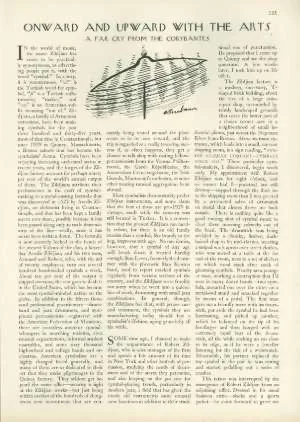
Image of the original 1958
New Yorker article.
Armand Zildjian: Some Cymbals Needed More Aging
Perhaps the most revealing observation came directly from Armand Zildjian, who served as the company's production manager and chief cymbal tester.
During the factory visit, Armand demonstrated the process of evaluating newly manufactured ride cymbals. He listened carefully for stick definition, overtone balance, and musical responsiveness, accepting some cymbals while setting others aside.
Of particular interest was his observation concerning certain ride cymbals:
"Some of these ride cymbals could stand a little more aging, though."
This is a striking statement from one of the most influential figures in modern cymbal manufacturing.
Armand wasn't simply discussing antique cymbals or repeating a traditional belief. He was evaluating actual instruments and expressing the opinion that additional aging might improve their sound.
His observation suggests that, at least in his experience, a cymbal's tonal character was not necessarily fixed immediately upon completion of the manufacturing process.
Which makes the point that many others have as well: Cymbals continue to change long after they have been manufactured.
The Complexity of Cymbal Bronze
Cymbals are remarkable musical instruments.
Traditional cast cymbals are commonly manufactured from B20 bronze, an alloy consisting of approximately 80% copper and 20% tin. Producing a musical instrument from this material requires substantial processing. Casting, heating, rolling, hammering, and lathing all contribute to the physical characteristics that determine how a cymbal responds when struck. The 1958 article describes the extraordinary care that went into these processes at Zildjian, including repeated heating, rolling, and cooling operations. Yet even after these manufacturing steps, the Zildjian family believed that allowing additional time before final evaluation was worthwhile.
This raises an intriguing question: What, if anything, happens to a cymbal's tonal characteristics after manufacturing?
The relationship between bronze metallurgy, residual stress, vibration, and acoustic behavior is complex. Historical manufacturing traditions do not, by themselves, establish that a cymbal's sound necessarily changes during storage. Nevertheless, the Zildjian family's practices reveal that the possibility of continued tonal development was taken seriously by some of the most experienced cymbal makers in the world.
Aging Versus Playing-In: An Important Distinction
When discussing cymbal maturation, it's important to distinguish between two related concepts.
Aging refers to changes that may occur as time passes following manufacture.
Playing-in refers to changes that musicians believe may occur through repeated striking, flexing, and vibration during normal use.
While traditional manufacturers sometimes allowed months or even years for cymbals to mature, generations of drummers have also described changes they perceive through extended playing.
Both traditions raise questions worthy of further investigation.
Rediscovering an Old Question
Today, most cymbals are manufactured, evaluated, and distributed without the lengthy factory aging periods described in the 1958 article, thought is understood that both Zildjian and their Canadian cousins up at Sabian still factory age their stock before sending their instruments out into the world.
Yet the question of cymbal maturation persists: Can a cymbal's responsiveness evolve after manufacture? Does repeated vibration influence its acoustic behavior? And can any such changes be measured, reproduced, or intentionally encouraged?
These questions are part of what inspired the development of Cymbal Vivo.
Cymbal Vivo is a vibration-conditioning device designed to subject a cymbal to sustained mechanical vibration without requiring a drummer to continuously play it. Its purpose is to explore and facilitate the process commonly described by drummers as playing-in.
The historical Zildjian practice of factory aging does not prove that vibration conditioning accelerates aging, and the two processes should not be considered scientifically equivalent.
But the connection is fascinating: more than six decades ago, the people responsible for some of the world's most celebrated cymbals believed that time could contribute to the development of an instrument's sound.
At Cymbal Vivo, we believe that tradition presents an intriguing question worth exploring through modern technology and careful listening.
A Legacy Worth Remembering
One of the most compelling aspects of the 1958 interview is the attention Armand Zildjian devoted to the individuality of every cymbal. Armand understood that even two cymbals made from similar materials and subjected to similar manufacturing processes could exhibit distinctly different tonal characteristics. His role was not merely to manufacture cymbals but to listen, evaluate, and recognize the musical potential of each instrument. And sometimes, he believed, a cymbal could benefit from more time.
For drummers interested in the relationship between craftsmanship, vibration, and tonal development, that observation remains just as intriguing today.
Historical Source
J. M. Flagler, "A Far Cry from the Corybantes," The New Yorker, December 6, 1958.
Historical observations reflect the beliefs and manufacturing practices documented in the original article. They should NOT be interpreted as an endorsement of Cymbal Vivo by the Zildjian company or by any party.
